

APRA's Prudential Handbook

Use the Prudential Handbook to access APRA’s policy and reporting expectations, including standards, guidance and related information.
All industries

About the Prudential Handbook

The Prudential Handbook is a way for regulated entities to interrogate the prudential framework – that is, the prudential and reporting standards and related guidance relevant to their industry.

The search on this page is configured to only search within the prudential framework. This helps entities focus on APRA’s policy expectations and find relevant policy content to understand their obligations. It is a useful tool for risk, compliance and regulatory affairs teams, amongst others. 

A broader range of news and information, including APRA’s priorities, statistical publications, can be found on other pages and by using search in the top right corner of the page. 

This information does not replace the Federal Register of Legislation, which contains the authorised versions of all prudential standards (and other legislative instruments made by APRA).
About APRA's prudential framework

APRA's prudential framework is a systematic approach to help entities understand the legal obligations it sets as well as expectations of entity practice.

APRA legal requirements are captured in the form of prudential and reporting standards. There are specific requirements for each of the banking, insurance and superannuation industries as well as cross-industry standards that apply to some or all industries.

These legally binding prudential and reporting standards, along with supporting guidance such as practice guides, letters and FAQs, make up APRA's prudential framework.

How the framework is structured

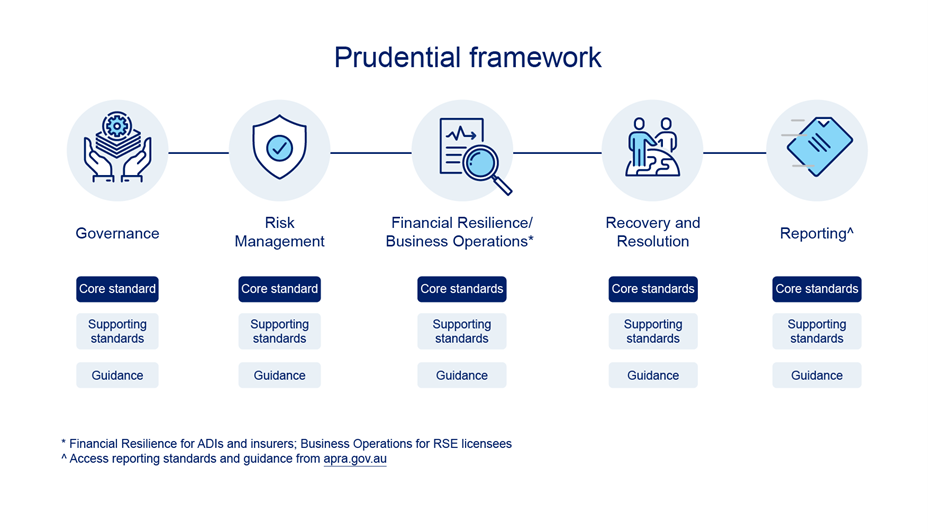
The prudential framework is organised into pillars. Each pillar focuses on one aspect of an entity's legal responsibilities, including the risks they must manage.

All industries have obligations in the Governance, Risk Management, Recovery and Resolution, and Reporting pillars. The fifth pillar depends on the industry: Financial Resilience is relevant to banking and insurance, while Business Operations applies to superannuation.

Prudential framework diagram with five sections: Governance, Risk Management, Financial Resilience, Recovery, and Reporting. Each includes core standards, supporting standards, and guidance.

Sub-pillars within each pillar further group similar standards and guidance together. For example, standards in the Risk Management pillar are further differentiated into categories such as Operational Risk, Credit Risk and Market Risk.

Each pillar contains core standards, supporting standards and guidance. Core standards set foundational requirements. Supporting standards are narrower in focus, providing extra detail about certain risks or industries. Guidance typically means prudential practice guides (PPGs), but also includes letters, FAQs and information papers. These provide APRA’s view of sound practice in particular areas.

The Pillars

Governance

Governance standards require entities to act with honesty and integrity, and to be run by people with the right skills, knowledge and experience. The Governance pillar includes requirements for good governance, and the fitness and propriety of people in positions of responsibility. It applies to all industries.  

Risk Management

Risk Management standards require entities to maintain effective risk management strategies and systems. The Risk Management pillar includes requirements about managing operational risk, and risks specific to an industry including credit risk, insurance risk and investment risk. It applies to all industries.

Financial Resilience (banking and insurance)

Financial Resilience standards require entities to maintain adequate financial resources to withstand stresses. The Financial Resilience pillar includes requirements such as maintaining capital and liquidity. It applies to the banking, general insurance, life insurance and private health insurance industries.

Business Operations (superannuation)

Business Operations standards require RSE licensees to manage their business operations to achieve the outcomes they seek for members. The Business Operations pillar includes requirements for strategic planning, investment governance, operational risk resourcing and insurance. It only applies to the superannuation industry.

Recovery and Resolution

Recovery and Resolution standards require entities to strengthen crisis preparedness. The Recovery and Resolution pillar includes requirements such as resolution, recovery and exit planning. It applies to all industries.

Reporting

Reporting standards define the data APRA regulated entities are required to report and the reporting schedule.

Prudential and reporting standards

Prudential and reporting standards set out APRA’s legally binding requirements for regulated entities. Select an industry below to access the relevant prudential and reporting standards.

Footnotes