


Executive summary
Effective governance is a fundamental driver of sustainable performance and resilience, underpinning community confidence and system safety. Its value is especially apparent in adverse conditions. When an organisation encounters heightened uncertainty, financial stress, operational disruption or conduct issues, governance arrangements shape whether decisions are timely and informed, and whether it can adapt to seize opportunities and mitigate risks.
This is evident in APRA’s supervisory experience and recent global failures. In APRA’s experience, entities under stress often have governance weaknesses. Supervision and enforcement frequently trace issues to poor oversight, unclear accountability or weak challenge. Prior international failures reinforce the same pattern. Reviews of Silicon Valley Bank found boards and management failed to manage risks effectively. Credit Suisse lost confidence after repeated governance and management failures.
Emerging risks further test governance. In areas such as artificial intelligence, cyber risk and geopolitical disruption, where technology is increasingly embedded in decision-making and operations, strong boards are setting clear direction, defining risk appetite and ensuring effective oversight. They are testing management assumptions and capability, monitoring emerging exposures and acting early as risks evolve. Weaker governance leads to slower, less coordinated responses and increases the likelihood of losses or loss of confidence. Together, these developments highlight the need for governance frameworks to keep pace with increasing complexity and change. This includes ensuring that regulated entities are equipped to oversee the safe, effective and accountable use of emerging technologies such as AI.
In response, APRA’s governance review aims to set clear, contemporary requirements for boards and senior managers. Proposed updates reinforce good governance practice in line with the critical role APRA-regulated entities play in maintaining trust and stability in the financial system.
APRA is now consulting on a new draft Prudential Standard CPS 510 Governance (CPS 510). It follows a discussion paper in March last year which set out priorities for reform, and a letter in October about how policy proposals have changed in response to feedback. The draft CPS 510 is intended to deliver clearer accountability, stronger oversight and more efficient governance by:
- strengthening and modernising requirements for board governance, conflicts management and fitness and propriety of executive and board members;
- improving organisational efficiency by enabling boards to delegate APRA’s board requirements in other prudential standards and aligning governance requirements with other codes and regimes where appropriate;
- removing duplicative reporting required under fit and proper, now that Financial Accountability Regime reporting is in place; and
- harmonising requirements by combining five existing prudential standards into one and setting consistent governance minimums for all APRA-regulated entities.
APRA welcomes feedback on the draft CPS 510, removing fit and proper reporting, and related definitional changes in Prudential Standard CPS 001 Defined terms. APRA will conduct meetings to answer questions and collect feedback through to the end of August. This engagement will inform the final standard and related guidance, planned for release in late 2026. APRA expects new requirements to be in effect from early 2028.
Glossary
| Term | Definition |
|---|---|
| ADI | Authorised deposit-taking institution |
| Accountable person | An accountable person as defined in section 10 of the FAR Act |
| ASX | Australian Securities Exchange |
| Board | Board of directors of an institution or, for an RSE licensee, the Board of directors or group of individual trustees of an RSE licensee, as applicable |
| Corporations Act | Corporations Act 2001 |
| CPS 001 | Prudential Standard CPS 001 Defined terms |
| CPS 510 | Prudential Standard CPS 510 Governance |
| CPS 511 | Prudential Standard CPS 511 Remuneration |
| CPS 520 | Prudential Standard CPS 520 Fit and Proper |
| FAR Act | Financial Accountability Regime Act 2023 |
| HPG 510 | Prudential Practice Guide HPG 510 Governance |
| Non-executive director | A director who is not a member of the regulated entity’s management |
| PHI | Private health insurer |
| Responsible person | As defined in draft CPS 510 (including FAR accountable persons, auditors, actuaries and, for RSE licensees, the RSE secretary; and other persons determined by APRA in limited circumstances) |
| RSE | Registrable superannuation entity |
| RSE licensee | RSE licensee as defined in section 10(1) of the SIS Act |
| SFI | Significant financial institution |
| SIS Act | Superannuation Industry (Supervision) Act 1993 |
| SOOA | Senior Officer Outside of Australia as defined in CPS 510 |
| SPG 510 | Prudential Practice Guide SPG 510 Governance |
| SPG 521 | Prudential Practice Guide SPG 521 Conflicts of Interest |
| SPS 510 | Prudential Standard SPS 510 Governance |
| SPS 520 | Prudential Standard SPS 520 Fit and Proper |
| SPS 521 | Prudential Standard SPS 521 Conflicts of Interest |
1. Introduction
Strong governance is fundamental to the safety, resilience and performance of APRA-regulated entities, which in turn play a central role in the economy and for the Australian community. Boards set strategy, oversee risk and shape the culture of their organisations to ensure sound decision-making. Senior managers are responsible for delivering the board’s strategy, managing the entity in a sound and prudent manner and equipping the board with the information needed for effective oversight and decision-making. This is especially critical during stress and uncertainty, which are features of the current operating environment. APRA’s supervisory experience continues to show that where governance arrangements are weak, risks are more likely to crystallise into issues.
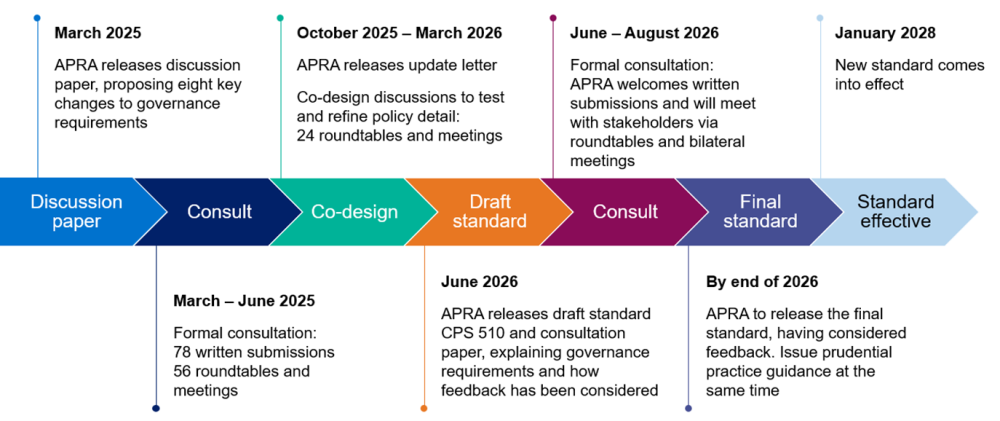
APRA’s governance review commenced with the release of a discussion paper in March 2025. In October 2025, APRA provided an update on key policy positions. This paper accompanies APRA’s new draft governance standard (CPS 510) and amendments to CPS 001 and explains how the review has taken feedback from industry and governance practitioners into account.
A wide range of stakeholders have contributed to the review, in and outside of formal consultation periods. There is broad recognition of the need for robust governance practices across financial services and support for consistent minimums. Stakeholders advocate for flexibility where possible, so that entities can achieve desired outcomes in ways that fit their risks and business models. Where possible without compromising standards, APRA stepped back from more prescriptive requirements in response to stakeholder concerns about cost, feasibility and unintended consequences. APRA has sought to place greater emphasis on principles‑based expectations supported by clear minimum requirements. At the same time, APRA has maintained proposals where supervisory experience, current industry practice and international best practice for prudentially regulated institutions indicate specific requirements are necessary. Attachment A provides further detail on feedback received to date and APRA’s response.
APRA thanks stakeholders for engaging with the review. The input has helped to ground requirements in contemporary good practice and streamline existing settings. Having tested elements of the draft standard with stakeholders, APRA now invites feedback on the complete draft.
Governance review timeline
Aims of reform
In developing the draft CPS 510, APRA has sought to strengthen governance outcomes while minimising compliance costs. Draft CPS 510 sets minimum requirements, but the way an entity meets them should be proportionate to its size, complexity, risk profile and structure. In some domains, such as board performance assessments and committee requirements, the standard explicitly sets a higher bar for significant financial institutions (SFIs).
APRA has also sought to reduce overlap between fit and proper requirements and the FAR Act. APRA proposes to narrow the cohort of responsible persons and removing routine fit and proper reporting requirements for remaining responsible persons.
APRA focused on minimising costs to industry. Initial estimates suggest that, in aggregate, the cost of this reform would be broadly neutral for industry. Some parts of the reform may require additional investment to meet APRA's new requirements, while other elements reduce existing requirements. The changes to reporting requirements would mean forms are no longer required to be submitted for 6000 individuals.
Draft CPS 510 relies on definitions in CPS 001, a cross-industry glossary for the prudential framework. APRA has taken the opportunity in this consultation to extend CPS 001 to include definitions from superannuation standards, alongside minor amendments to existing banking and insurance definitions. This is intended to improve consistency, reduce fragmentation and make CPS 001 the primary reference point for defined terms in the prudential framework for all industries.
As part of this consultation, APRA seeks feedback on:
- the new consolidated draft CPS 510;
- related definitional changes to CPS 001, which includes definitions for superannuation for the first time; and
- implications of removing routine reporting for its fit and proper regime (reporting forms SRS 520.0 Responsible Persons Information and CRF 520 Responsible Persons under CPS 520 Fit and Proper).
2. Policy proposals
This chapter provides an overview of the draft CPS 510 and related changes to draft CPS 001. It describes each section of the revised CPS 510 and what it intends to achieve. APRA expects that stakeholders will read the draft standards in parallel with this paper.
2.1 Prudential framework design and application
2.1.1 Framework design
The draft CPS 510 streamlines and consolidates APRA’s requirements for governance, fitness and propriety and conflicts management.
| Today | Under draft CPS 510 |
|---|---|
Five separate prudential standards across industries covering:
Largely similar, but at times inconsistent, expectations across industries | One consolidated, cross‑industry prudential standard CPS 510 Governance Consistent requirements for all APRA-regulated industries1 |
APRA will release a similarly unified prudential practice guide (CPG 510 Governance) when the standard is finalised in late 2026.
2.1.2 CPS 510 structure and objectives
| Part | Coverage | Objective |
|---|---|---|
| Part A – Board governance (locally incorporated entities2) | Governance framework | Clear accountability and decision‑making structures that support effective oversight, prudent management and sound governance outcomes in practice. |
| Board role and delegation | Boards focus on core prudential responsibilities with delegation used to support efficiency without diluting accountability or oversight. | |
| Senior managers and management information | Senior managers appropriately manage the activities of the entity and effectively support the board. | |
| Board composition and independence3 | Independent and impartial board judgement, including within group structures, supported by effective identification and management of director conflicts. | |
| Board committees and internal audit | Proportionate committee structures that support robust oversight of key prudential risks and frameworks. Independent assurance over the effectiveness of frameworks and controls. | |
| Board capability, performance and renewal | Boards maintain necessary collective skills and capabilities over time and assess performance regularly. | |
| Group governance (APRA-regulated head of a group4) | Governance arrangements operate effectively on a group basis, without obscuring independence and accountability for Australian regulated entities. | |
| Part B – Conflicts management (all entities) | Conflicts of interest | Potential and actual conflicts are identified, assessed and managed so decisions are made in the best interests of the entity or depositors, policyholders, and beneficiaries. |
| Part C – Fit and proper (all entities) | Fitness and propriety of responsible persons | Individuals in responsible person positions are capable, act with integrity, have the capacity to exercise sound judgement and are supported by effective assessment and reassessment processes. |
| Part D – Appointments (all entities) | Senior appointments | Senior appointments are made in the best interests of the regulated entity. |
| Part E – Special provisions | Foreign ADIs, Category C insurers and eligible foreign life insurance companies | Fit for purpose governance arrangements to support the sound and prudent management of Australian operations. |
For ease of reference, Attachment B of this paper provides a summary of artefacts and actions required under the draft CPS 510.
2.2 Board governance
Locally incorporated entities only
This part strengthens board governance by clarifying core board responsibilities, enabling delegation, improving information flows to boards and committees and lifting standards for skills, performance assessments and renewal. It is designed to support stronger governance outcomes without unnecessary prescription.
2.2.1 Governance framework
| What the draft CPS 510 does | What this is intended to achieve |
|---|---|
| Requires all locally incorporated regulated entities to maintain an effective, integrated governance framework covering roles, responsibilities and key governance processes. | Clear and consistent accountability and decision-making structures that operate effectively in practice. |
Draft CPS 510 sets out that a governance framework comprises the rules, processes, roles and practices that define and guide how an entity is directed, controlled and held accountable. Most regulated entities already document this information in various policies. SPS 510 currently requires RSE licensees to have a governance framework and APRA proposes to extend this requirement to banking and insurance entities. Where a regulated entity already has policies and processes that satisfy the draft requirements, they do not need to be duplicated.
2.2.2 Role of the board
| What the draft CPS 510 does | What this is intended to achieve |
|---|---|
| Clarifies the board’s core prudential responsibilities and reinforces its ultimate accountability, while allowing delegation of other, non-core matters. | Boards focus on strategy, risk, culture, oversight and challenge. |
Regulated entities have consistently provided feedback that their boards spend too much time on varied compliance matters, which takes focus away from their key responsibilities. APRA seeks to clarify the core prudential responsibilities of the board and make clear that other, non-core matters may be delegated to a Board committee or senior managers.
2.2.3 Delegation of authority
| What the draft CPS 510 does | What this is intended to achieve |
|---|---|
| Explicitly permits board delegation to board committees and senior managers, subject to documented guardrails, monitoring and review. | Effective use of delegation without dilution of accountability or oversight. |
APRA seeks to empower boards to spend more time on forward-looking strategy, risk, oversight and challenge.
The current CPS 510 already enables boards to delegate in certain circumstances. APRA proposes to make this more explicit, so that boards can delegate with confidence. Boards should be able to delegate matters to a board committee or senior managers, subject to the role of the board outlined in the previous section. This applies to board requirements set across APRA’s prudential standards. APRA has also enhanced requirements to ensure that when boards do delegate, this is supported by prudent guardrails.
2.2.4 Role of senior managers
| What the draft CPS 510 does | What this is intended to achieve |
|---|---|
| Introduces role of senior managers. Introduces explicit requirements related to the quality, timeliness and relevance of information provided to the board, supported by policy and processes. | Senior manager activities are consistent with entity’s objectives and culture, and their role is distinct from the Board’s role. Boards receive the right information, at the right time, to support informed risk‑based decisions. |
Draft CPS 510 articulates the key responsibilities of senior managers, including the responsibility to carry out and manage the regulated entity’s activities consistent with the entity’s strategy, plans, risk appetite, policies and culture.
The draft standard also introduces explicit minimum requirements for locally incorporated regulated entities relating to the quality, timeliness and usefulness of information provided to the board, supported by policy and processes. Similar requirements apply for foreign branch operations in relation to the SOOA.
2.2.5 Board composition
| What the draft CPS 510 does | What this is intended to achieve |
|---|---|
| Harmonises minimums for board size and residency across all locally incorporated regulated entities. | Boards have sufficient capacity and the breadth of local expertise needed to perform their role. |
CPS 510 currently sets a minimum board size of five for banks and insurers, while SPS 510 does not set a minimum for RSE licensees. Draft CPS 510 sets a minimum requirement of five across industries.
SPS 510 currently requires a majority of directors to be ordinarily resident in Australia; CPS 510 requires this of banks and insurers only where they are locally owned. APRA proposes to extend this expectation across all regulated entities incorporated in Australia, including those that are foreign-owned.
2.2.6 Independence (banks and insurers)
| What the draft CPS 510 does | What this is intended to achieve |
|---|---|
| Updates independence definition and extends the application of independence requirements within group structures. | Independent and impartial board judgement, including within group structures. Additionally, that director conflicts arising from other roles in the group are considered during the appointment stage (and on an ongoing basis). |
APRA expects that the board of each regulated entity, including those within wholly owned group structures, exercises independent judgement in overseeing the entity’s affairs, particularly where this is necessary to safeguard safety and soundness. APRA seeks to reinforce this expectation in draft CPS 510 by:
- extending the requirement to have a majority of independent directors to all APRA-regulated subsidiaries; and
- removing the assumption (currently in CPS 510) that a director assessed as independent at the parent level is automatically independent on a regulated subsidiary board.
As independence is context specific, all directors appointed as independent to a regulated entity board must satisfy the CPS 510 independence test in relation to that entity, including explicit consideration of actual or potential conflicts arising from intra‑group relationships (and that these are considered both during appointment and on an ongoing basis).
APRA recognises that the Corporations Act permits directors of a wholly owned subsidiary, where expressly authorised by the entity’s constitution and subject to conditions, to act in the best interests of the holding company. Draft CPS 510 does not seek to alter directors’ legal duties or restrict the lawful operation of group structures. It does not require subsidiary boards to operate in isolation from the group, nor does it imply that group interests are irrelevant. Rather, it reflects APRA’s expectation that group arrangements must not impede a regulated entity board’s ability to consider issues through the lens of the entity’s own risk profile, obligations and prudential position.
Further guidance will be provided in draft CPG 510 when it is released, including illustrative examples of how entities may assess and support independence in group contexts.
2.2.7 Board committees
| What the draft CPS 510 does | What this is intended to achieve |
|---|---|
| Harmonises baseline committee requirements, extends risk committee requirements to RSE licensees, and allows flexibility for non-SFIs. | Robust and proportionate committee structures that support effective oversight of prudential risks. |
Boards remain ultimately responsible for the actions of board committees, but committees can play a key role and support robust oversight of key prudential risks. Draft CPS 510 sets baseline requirements for board committees which have responsibility for prudential requirements. To ensure that boards remain ultimately responsible, this includes a requirement that all members of each committee be non-executive directors. This requirement does not intend to limit others from attending committee meetings, only clarify who can be voting members.
Draft CPS 510 also harmonises committee requirements for risk, audit and remuneration committees, which currently sit across CPS 510, SPS 510 and CPS 511, while introducing the option for non-SFIs to combine risk and audit committees.
2.2.8 Board skills and capability
| What the draft CPS 510 does | What this is intended to achieve |
|---|---|
| Requires boards to document collective skills needs through a structured skills matrix and address gaps over time. | Boards collectively have the capability needed to oversee complex business and risk environments. |
APRA proposes to require entities to take a structured and forward‑looking approach to identifying, assessing and addressing board skills and capability needs. This is intended to support boards to collectively possess the skills, experience and behavioural attributes necessary to oversee strategy, risk and performance in an increasingly complex operating environment.
Draft CPS 510 requires entities to have board skills matrices, featuring clear assessment criteria, and actively address identified skill or capability gaps. These changes raise the bar for how boards ensure they are equipped to perform their role effectively now and in the future.
2.2.9 Board, committee and director performance
| What the draft CPS 510 does | What this is intended to achieve |
|---|---|
| Strengthens annual board, committee and director assessments and introduces triennial independent reviews for SFIs. | Performance assessments drive continuous improvement rather than compliance. |
Performance assessments are critical in identifying strengths and areas for improvement for boards, their committees and individual directors. Effective performance assessments are rigorous, outcomes-focused and generate high-quality recommendations to the board to improve performance.
APRA proposes to strengthen the scope, quality and use of annual performance assessments. Draft CPS 510 adds specific requirements relating to the scope of annual performance reviews, including assessing the performance of committees, the appropriateness of the skills matrix and evaluating the processes that comprise the governance framework.
For SFIs, APRA proposes to require a triennial independent performance assessment conducted by an appropriate external expert. This is proposed to have an expanded scope to evaluate more specific features of performance in depth. APRA will outline expectations on maintaining the independence of board reviewers in draft guidance related to CPS 510.
APRA also proposes that regulated entities be able to demonstrate progress against accepted recommendations from both annual and triennial performance assessments.
2.2.10 Board renewal and non-executive director tenure
| What the draft CPS 510 does | What this is intended to achieve |
|---|---|
| Introduces a 12-year default tenure limit for non-executive directors, supported by renewal and succession planning requirements. | Sustainable board renewal balancing continuity with fresh perspectives. |
RSE licensees are already subject to requirements relating to board renewal in SPS 510. APRA proposes to streamline the existing requirements relating to renewal in superannuation and extend them to banking and insurance.
Draft CPS 510 includes a 12-year tenure limit for non-executive directors, reflecting an expectation that already exists in APRA guidance for superannuation and private health insurance. This new requirement seeks to balance continuity and institutional knowledge with the need for planned renewal, fresh perspectives and evolving skills. Tenure requirements are intended to capture total time served by an individual on the board of an entity. For clarity, tenure includes:
- total time irrespective of whether this has been served in consecutive appointment terms;
- the time an alternate director acts in the capacity as a non-executive director;5 and
- any tenure as a director on a predecessor entity in the event of a merger or transfer.
APRA’s proposal outlines that a Board may approve an extension in each individual circumstance of up to an additional 12 months. APRA intends for this to be used by boards in exceptional circumstances to provide short-term flexibility (e.g. managing around annual general meetings or other short-term commitments, unexpected delays in new appointments). APRA proposes that an entity must notify APRA of an extension within 10 days of board approval.
2.3 Conflicts management
All APRA-regulated entities
This part sets consistent conflicts management requirements for all entities. They support confidence that individuals in key roles exercise independent judgement in the interests of beneficiaries, policyholders or depositors as relevant.
APRA aims to promote conflicts management arrangements that operate effectively in practice, support entities to meet their obligations and are consistent with existing conflicts management requirements in legislation and ASIC’s Regulatory Guide 181 - AFS licensing: Managing conflicts of interest.
RSE licensees are subject to some specific requirements in this part, due to SIS Act requirements and their unique obligations to beneficiaries.
| What the draft CPS 510 does | What this is intended to achieve |
|---|---|
| Establishes a single cross-industry conflicts framework requiring proactive identification, management and monitoring of conflicts. | Conflicts are managed effectively so decisions are made in the interests of beneficiaries, policyholders or depositors as relevant. |
APRA proposes to create a single cross-industry set of requirements, which for superannuation would replace the current SPS 521. In doing so, APRA will create baseline requirements that all regulated entities must proactively identify, assess and manage actual and potential conflicts of interest and duty, including those arising from intragroup arrangements. This includes a requirement to maintain a register of potential and actual conflicts.6
APRA also proposes to require that all entities have a conflicts management policy which defines roles and responsibilities, the controls to ensure they fulfil their conflicts management obligations and is reviewed annually. Where an entity already has policies and processes that satisfy the draft requirements as part of their risk management framework, these do not need to be duplicated.
2.4 Fitness and propriety
All APRA-regulated entities
This part strengthens fitness and propriety requirements, which are fundamental to effective governance, accountability and prudent decision-making. APRA’s objective is to strengthen these requirements while reducing unnecessary complexity and duplication. APRA seeks to clarify requirements, improve consistency across industries and better align prudential requirements with FAR and other legislative requirements.
APRA’s fit and proper regime intends to complement FAR. FAR remains the primary mechanism for accountability of senior executives and directors, while fit and proper requirements focus on assessing suitability during the appointment process and ongoing oversight over fitness and propriety.
2.4.1 Responsible person definition, notification and reporting
| What the draft CPS 510 does | What this is intended to achieve |
|---|---|
| Narrows responsible person scope to align with those already captured by FAR or other legislation. Removes all routine reporting requirements for responsible persons. | Reduced duplication and compliance burden while preserving accountability. |
Regulated entities have provided feedback that processes and reporting are heavily duplicated between fit and proper and FAR requirements. To reduce duplication, APRA proposes to:
- narrow the cohort of responsible persons to include accountable persons, auditors, actuaries and RSE licensee secretaries, removing a layer of complexity from the current responsible person definition; and
- remove requirements to provide information on responsible persons, consequently removing all reporting requirements (except for where entities determine a person is not fit and proper).
Draft CPS 510 retains the requirement for entities to notify APRA where they determine a person is not fit and proper.
2.4.2 Fit and proper assessments
| What the draft CPS 510 does | What this is intended to achieve |
|---|---|
| Introduces a requirement to take all reasonable steps to ensure responsible persons are fit and proper and introduces fit and proper reassessment requirements. | Robust fit and proper processes and responsibility for outcomes on an ongoing basis. |
Currently, entities are required to conduct annual assessments of fitness and propriety for responsible persons. APRA expects that entities undertake a thorough process and are responsible for the outcomes of these assessments. APRA proposes that CPS 510 requires an entity to:
- take all reasonable steps to ensure responsible persons are fit and proper; and
- reassess a responsible person’s fitness and propriety in certain circumstances (including where APRA has concerns).
For directors, annual validations of their fitness and propriety, as proposed to be required under draft CPS 510 may be undertaken as part of the annual performance assessment (see Section 2.2.9).
2.4.3 Fit and proper criteria
| What the draft CPS 510 does | What this is intended to achieve |
|---|---|
| Harmonises fit and proper criteria across industries and introduces information that must be considered in assessments. For directors and SOOAs, requires that they have time and capacity to perform the role. | Ensure that individuals in responsible persons positions are appropriately skilled, experienced and act with integrity. |
The fitness and propriety of people in responsible person positions is critical to good governance. Properly assessing fitness and propriety requires consideration of many factors and information sources.
Draft CPS 510 also harmonises fit and proper criteria across industries. In effect, banks and insurers must now additionally be satisfied that the education, technical qualifications and experience of the person are suitable to the position. APRA expects that this reflects current industry practice in most circumstances.
As set out in the March 2025 discussion paper, APRA expects that for director or SOOA roles, an entity would properly consider an individual’s ability to balance multiple roles and professional obligations.
APRA also proposes that in assessing a person’s fitness and propriety, entities must consider professional references, and findings from any court, tribunal, regulator, board, arbitrator, public inquiry or other relevant body and for director roles, the skills needed under the Board skills matrix. APRA believes these are important factors to consider when assessing fitness and propriety but does not intend for them to ‘automatically’ trigger a particular outcome.
2.4.4 Fit and proper policy
| What the draft CPS 510 does | What this is intended to achieve |
|---|---|
| Updates requirements for regulated entities’ fit and proper policy and associated processes. | Clarifying expectations and documentation around fit and proper processes, decision‑making and operation in practice. |
The draft CPS 510 consolidates and updates the fit and proper policy requirements previously set out in CPS 520 and SPS 520. The proposed requirements more clearly require a regulated entity to have a fit and proper policy that articulates roles and responsibilities, the type of information that it will collect in assessing fitness and propriety, retention periods, and articulate for directors how the Board skills matrix will be considered in making a determination.
The draft CPS 510 also brings greater coherence by integrating reassessment triggers, consequences of adverse assessments, and non‑constraint obligations within a single, consolidated policy. This supports more consistent application across industries and integration with broader governance requirements like the skills matrix.
2.5 Special provisions
Foreign ADIs, Category C insurers and Eligible Foreign Life Insurance Companies only
This part sets governance requirements for entities operating in Australia through foreign branches. These requirements simplify and adapt for foreign branches the board governance requirements proposed for locally incorporated entities (see 2.2 Board governance).
APRA recognises that foreign branches often run simpler local businesses, are smaller in size and have different legislative requirements compared to locally incorporated entities. At the same time, governance remains fundamental to the safety and soundness of these institutions and APRA believes it is appropriate that these entities have comparable governance arrangements.
Requirements in this section are similar in intent, where relevant, to those set for boards of locally incorporated entities, but reflect differences in business models, size, legislative requirements and other prudential standards.
| What the draft CPS 510 does | What this is intended to achieve |
|---|---|
| Clarifies the core prudential responsibilities of the SOOA, while allowing delegation of other matters to local senior managers. | The SOOA focuses on strategy, risk, oversight and challenge. |
The SOOA plays a critical role in the governance of foreign branches. APRA seeks to clarify the roles and responsibilities of the SOOA and enable it to delegate appropriate matters to local senior managers.
| What the draft CPS 510 does | What this is intended to achieve |
|---|---|
| Updates remuneration and audit obligations for foreign branches (to align with updated Board Remuneration and Audit Committee requirements of locally incorporated entities). | Robust and proportionate compliance functions that support effective oversight of prudential risks. |
Draft CPS 510 consolidates existing remuneration and audit obligations for foreign branches and updates them to promote consistency with requirements of other entities and APRA’s other prudential standards.
2.6 Other sections of CPS 510 Governance
This paper does not include detailed commentary on sections of the draft CPS 510 where APRA has not substantively changed requirements from current prudential standards. This includes Part D of the standard, obligations relating to internal audit, the Head of a group, the auditor independence test and additional fit and proper criteria for auditors and actuaries. Whistleblowing requirements have been amended, or removed where they are no longer relevant, to align with consequential changes made in legislation.
2.7 CPS 001 Defined terms
Draft CPS 510 uses terms defined in CPS 001. APRA has taken the opportunity in this consultation to extend CPS 001 to include definitions from superannuation standards, alongside making minor amendments to existing banking and insurance definitions. This is intended to improve consistency, reduce fragmentation and make CPS 001 the primary reference point for defined terms in the prudential framework for all industries.
Definitions that are used primarily for the current CPS 510 have been kept in draft CPS 510. APRA has clarified and moved the definition of senior manager from CPS 520 and SPS 520 to CPS 001, as that term is used in other prudential standards.
3. Consultation
Informed by consultation, APRA intends to release the final CPS 510 and prudential practice guidance CPG 510 by the end of 2026.
| Timeline for reform | |
|---|---|
| Consultation package release | 16 June 2026 |
| Submissions deadline | 28 August 2026 |
| Release final CPS 510 and CPG 510 | Q4 2026 |
3.1 Questions
APRA welcomes general feedback on the draft CPS 510 and CPS 001. APRA also invites specific advice on the following questions.
1. Proportionality and transition
Do the draft CPS 510 requirements operate proportionately across different entity types, sizes and structures, and are transitional arrangements needed in specific areas to support orderly and timely implementation?
2. Reviews and assessments
Are the reviews and assessments required by the draft standard appropriately scoped, and do the mechanics provide sufficient flexibility to allow reviews to be combined where this supports efficiency and effectiveness?
3. Fit and proper streamlining and FAR alignment
Do the proposed changes appropriately reduce duplication, including the removal of routine reporting and the narrowing of the responsible person cohort? Are there any risks or unintended consequences APRA should consider?
4. Areas where further detail in guidance would assist
APRA will release a prudential practice guidance to accompany the final governance standard CPS 510. What further information would assist entities to confidently implement the standard?
5. Compliance costs and net impact
What are the expected compliance costs and benefits of the proposed changes, including the net impact once reductions from consolidation and streamlining are considered?
6. Artificial intelligence governance
Do the draft CPS 510 requirements adequately support the oversight and use of AI and related technologies? Are there areas where additional expectations or guidance would assist?
3.2 Request for submissions
APRA invites written submissions in response to this discussion paper. Submissions are welcome to address any aspect of the discussion paper. Stakeholders are also invited to provide views on the proposals and accompanying questions. They should be sent to PolicyDevelopment@apra.gov.au by 28 August 2026 and addressed to:
General Manager
Policy and Frameworks
Policy and Advice Division
Australian Prudential Regulation Authority
During the consultation period, APRA expects to hold discussions with industry and other stakeholders to explore the issues and options identified by this paper and their anticipated impacts. This engagement will inform final revisions to governance requirements, which will be released in late 2026.
3.2.1 Important disclosure information
All information in submissions will be made available to the public on the APRA website unless a respondent expressly requests that all or part of the submission is to remain in confidence. Automatically generated confidentiality statements in emails do not suffice for this purpose.
Respondents who would like part of their submission to remain in confidence should provide this information marked as confidential in a separate attachment.
Submissions may be the subject of a request for access made under the Freedom of Information Act 1982 (FOIA). APRA will determine such requests, if any, in accordance with the provisions of the FOIA. Information in the submission about any APRA-regulated entity that is not in the public domain and that is identified as confidential will be protected by section 56 of the Australian Prudential Regulation Authority Act 1998 and will therefore be exempt from production under the FOIA.
3.2.2 Request for cost-benefit analysis information
APRA asks that all stakeholders use this consultation opportunity to provide information on the compliance impact of the proposals, and any other substantive costs including business costs. Compliance costs are defined as direct costs to businesses of performing activities associated with complying with government regulation. Specifically, information is sought on any changes to compliance costs incurred by businesses because of APRA’s proposals.
Consistent with the Government’s approach, APRA will use the methodology behind the Regulatory Burden Measurement Framework to assess compliance costs. It is available at https://oia.pmc.gov.au/resources/guidance-assessing-impacts/regulatory-burden-measurement-framework.
APRA requests that respondents use this methodology to estimate costs to ensure the data supplied to APRA can be aggregated and used in an industry-wide assessment. When submitting cost assessments to APRA, respondents should include any assumptions made and, where relevant, any limitations inherent in their assessment. Feedback should address the additional costs incurred because of complying with APRA’s requirements, not activities that institutions would undertake due to foreign regulatory requirements or in their ordinary course of business.
Attachment A – Response to feedback
This attachment summarises feedback APRA received on proposals set out in the March 2025 discussion paper, and APRA’s response to the most substantive issues raised.
Stakeholder feedback strongly supported uplift in governance practices, with consistent themes around proportionality, flexibility and avoiding duplication. APRA has adjusted several proposals in response, particularly in relation to fitness and propriety reporting, independence in group structures and director tenure limits, while proceeding with reforms where supervisory experience indicates clear minimum expectations are necessary.
Summary of consultation feedback and APRA’s response
| Initial proposal | Consultation feedback | APRA’s response |
|---|---|---|
Proposal 1 – Skills and capabilities Require regulated entities to:
| Submissions supported this proposal, recognising that strong skills and capabilities lead to more effective boards. Some submissions requested clarity that boards can define the skills that they need. | Proceed, with clarifications APRA is proceeding with this proposal with slight amendments for clarity. APRA does not propose to prescribe specific skills. Boards are best placed to determine what they need. |
| Some submissions were concerned that defining specific skillsets for each individual director role could undermine collective board accountability and decision-making. | Proceed, with clarifications As communicated in APRA’s October 2025 letter, APRA does not propose that each individual director role should have its own prescribed mix of skills. However, APRA proposes that:
APRA intends to provide further guidance in CPG 510. | |
Proposal 2 – Fitness and propriety Require SFIs, and non-SFIs under heightened supervision, to engage proactively with APRA on potential appointments. | Submissions strongly opposed early engagement with APRA on responsible person appointments citing privacy, delays and process risks. | Adjust APRA acknowledges these concerns and has adjusted proposals accordingly. APRA will not require that any entities reach out to APRA ahead of potential appointments. While it will not be a requirement, APRA still considers early regulator engagement ahead of key appointments (e.g. Chair and CEO) to be better practice. Entities who already engage APRA at this stage tend to appreciate any insights APRA may have and do not experience undue delay. Early engagement is also consistent with international regulatory codes (e.g. Basel Core Principles). In stepping back from this proposal, APRA has made a deliberate risk trade-off. APRA will not require entities to notify the regulator prior to an adverse fit and proper determination, to ensure procedural fairness for prospective candidates. However, it will still require that entities notify APRA following a determination that a person is not fit and proper. |
Proposal 2 – Fitness and propriety Require regulated entities to meet higher minimum requirements to ensure fitness and propriety of their responsible persons. | Submissions broadly supported a strengthened, outcomes-focused fit and proper regime. | Proceed APRA has proposed amended criteria and assessment requirements. |
Proposal 2 – Fitness and propriety Examine whether APRA can align role definitions and rely on reports it receives under the FAR rather than requiring two sets of reports. | Strong support to reduce duplication between FAR and fit and proper. | Proceed APRA is proposing to remove the requirement for regulated entities to lodge routine fit and proper forms. APRA will principally rely on information provided via FAR reporting. APRA also proposes to narrow the responsible person cohort to better align with FAR and remove complexity from the responsible person definition. |
Proposal 3 – Conflicts management Extend current RSE licensee conflict management requirements to banks and insurers so they are also required to:
| Submissions supported strengthening conflicts management and harmonising requirements across industries. | Proceed, with minor amendments APRA proposes to introduce consistent conflicts management requirements across industries. |
| Submissions supported maintaining registers of relevant conflicts and related interests and duties. However, banks and insurers opposed publicly disclosing these registers. | Proceed, with minor amendments As communicated in APRA’s October 2025 letter, APRA remains of the view that registers of relevant interests and duties are important tools for conflicts management. However, APRA is not convinced of the net benefit of public disclosure for banks and insurers and will not require this. The requirement for RSE licensees to publish these registers remains in primary legislation. | |
| Submissions strongly opposed including ‘perceived’ conflicts in the standard due to reliance on subjective judgement. | Adjust As communicated in APRA’s October 2025 letter, APRA intends to set this expectation to include perceived conflicts in guidance only, having regard to risks posed by making it a legal requirement. APRA sees value in considering perceived conflicts and believes it in line with contemporary practice and regulatory expectations. | |
Proposal 4 – Independence (banks and insurers only) Require at least two independent directors (including the chair) to not be members of any other board within the entity’s group. Make minor amendments to the independence criteria, including extending the prohibition on independence to include material holdings of any type of security. Extend the current requirement for bank and insurer boards to have a majority of independent directors to include boards of entities with a parent that is regulated by APRA or an overseas equivalent. | Strong opposition from respondents, particularly in the insurance industry, on the proposal to have two independent directors not on other group boards, with concerns about cost, feasibility and strategic alignment within the group. There was support for a principles-based solution to replace the prescriptive proposal. | Adjust APRA acknowledges the concerns relating to the difficulty in implementing this requirement. APRA will no longer proceed with its proposal for a uniform requirement. However, APRA remains of the view that independence, including within larger groups, is fundamental to good governance, and proposes several measures to reinforce this. See Section 2.2.6 for further detail. APRA expects that these measures will work in tandem with the new fit and proper and conflicts management requirements in CPS 510 to support effective management of intra-group conflicts throughout the appointment process for directors and on an ongoing basis. |
| Some submissions called for APRA to adopt the ASX Corporate Governance Principles and Recommendations (CGPR) definition of independence. | Proceed APRA proposes to adopt the ASX CGPR definition when revising the definition of independence. | |
| Most submissions were supportive of the majority independent director requirement extension. | Proceed APRA will proceed with this proposal unchanged. | |
Proposal 5 – Board performance review Require SFIs to:
| Submissions strongly supported the proposal for SFIs to commission independent triennial assessments. Some submissions expressed concern relating to the proposed requirement to submit the assessment to APRA as this may impact candour and independence. | Proceed, with minor amendments APRA will proceed with its uplift of performance assessment requirements. Given feedback received during consultation, APRA will no longer proceed with the requirement for SFIs to submit their assessment report to APRA. |
| Submissions suggested that APRA provide clarity on appropriate qualifications for independent board assessors. | Proceed APRA will not propose to specify reviewer qualifications in the standard due to the risk of being overly prescriptive in determining who may be commissioned. APRA proposes that the assessment utilise robust structure and evidence-based methodology and that the review is conducted by an external independent expert. | |
Proposal 6 – Role clarity Define APRA’s core expectations of the board, the chair and senior managers. Provide additional guidance on which APRA requirements may be delegated to board committees and senior managers. | Submissions strongly supported clarification of the role of the board and senior managers. Stakeholders recommended consistency with other codes and requirements where possible There was strong support for providing a more legally certain, flexible framework for boards to delegate to committees and management. APRA received mixed feedback regarding how the degree of prescription APRA should provide in what can be delegated. | Proceed, with minor amendments APRA proposes to outline core prudential responsibilities for the Board and clarify the ability to delegate all other APRA-required matters to board committees or senior managers whilst remaining accountable. |
| Submissions opposed defining the chair’s role on the basis that it may inadvertently weaken collective accountability of the board. | Adjust APRA often sees a direct correlation between an effective chair and an effective board and will elaborate on the chair’s role in guidance rather than the standard. | |
Proposal 7 – Board committees Extend the current requirement for bank and insurer boards to have separate risk and audit committees to apply to SFI RSE licensees as well. Repeal the above requirement for non-SFI banks and insurers, allowing flexibility for smaller entities. Mandate that only full board members can be voting members of APRA-required board committees. | Submissions supported the proposed requirement to separate risk and audit committees for SFIs whilst removing this requirement for non-SFIs. | Proceed APRA will proceed with this proposal. APRA remains of the view that separate committees remain best practice for all entities and encourages adoption where possible. |
| Most submissions, especially from RSE licensees, opposed the proposal to provide only full board members the ability to vote on committees. | Proceed APRA’s primary concern is preserving clear accountability for prudential decisions that sit with the board. Where committees are making decisions under delegated authority, APRA expects voting members to be directors so that decision‑making authority aligns to directors’ duties, collective accountability and the board’s ultimate responsibility under the standard. | |
Proposal 8 – Director tenure and board renewal Impose a lifetime default tenure limit of 10 years for non-executive directors at a regulated entity. Require regulated entities to establish a robust, forward-looking process for board renewal. | Most submissions agreed with the benefits of renewal and supported the need to manage succession planning. Many submissions opposed a fixed tenure limit of 10 years, arguing that boards ought to retain flexibility. Most regulated entity boards set a tenure limit in their renewal policies at between 9 and 12 years and agree that proactive planning is important for orderly renewal. Some submissions advocated for tenure limits to be in guidance, or to be set at 12 years rather than 10 years. This would limit the need to alter constitutions and provide sufficient flexibility. | Adjust APRA considers a hard limit is necessary to consistently strengthen renewal discipline and reduce the risk of entrenchment over time. Supervisory experience over the past decade has shown that supervision and guidance alone is ineffective in changing practices. APRA has adjusted the limit from 10 to 12 years. This is consistent with market practice, governance cycles, and existing superannuation and private health insurance guidance in SPG 510 and HPG 510 and provides a hard backstop. APRA also proposes that boards can approve an extension of up to 12 months in limited circumstances and must notify APRA where this is pursued. Further information on board-approved extensions, application on tenure limits in merger scenarios, and treatment of alternate directors is provided in Chapter 2. |
Attachment B – Summary of actions and artefacts required under draft CPS 510
| Category | Key actions and artefacts (together, the governance framework) |
|---|---|
| Foundational governance documents |
|
| Prescribed policies |
|
| Registers and records |
|
| Skills and capability artefacts |
|
| Reviews and assessments |
|
| Risk and control oversight |
|
| Conflicts and fit and proper assurance |
|
| Core governance processes (documented) |
|
| Management information outputs |
|
| Group‑related artefacts (where applicable) |
|
| APRA interaction and transparency |
|
Footnotes
1 Draft requirements are varied for specific cohorts or industries where necessary e.g. due to legislative differences.
2 Some concepts and requirements set out in Part A are mirrored or adapted for foreign branches in Part E.
3 Director independence requirements for banks and insurers only.
4 This section does not apply to RSE licensees or PHI entities.
5 A regulated entity may apply to APRA for an exemption from, or adjustment to, the requirement that time served as an alternate director be counted towards APRA’s tenure limit.
6 Primary legislation requires that, for RSE licensees, these registers are disclosed publicly. Banks and insurers are not required to disclose them.