

Executive summary
Sound investment governance by trustees is central to preventing member harm and maintaining confidence in the superannuation system. Although members ultimately bear investment risk in a defined contribution system, strong governance helps trustees identify emerging risks and act before they result in member harm.
The superannuation investment landscape is evolving. Investment offerings are becoming broader and more complex, member-directed investment is becoming more prevalent, and trustees are increasingly relying on advisers, promoters and other third parties. These developments increase the importance of strong trustee capability, independent decision-making and effective safeguards.
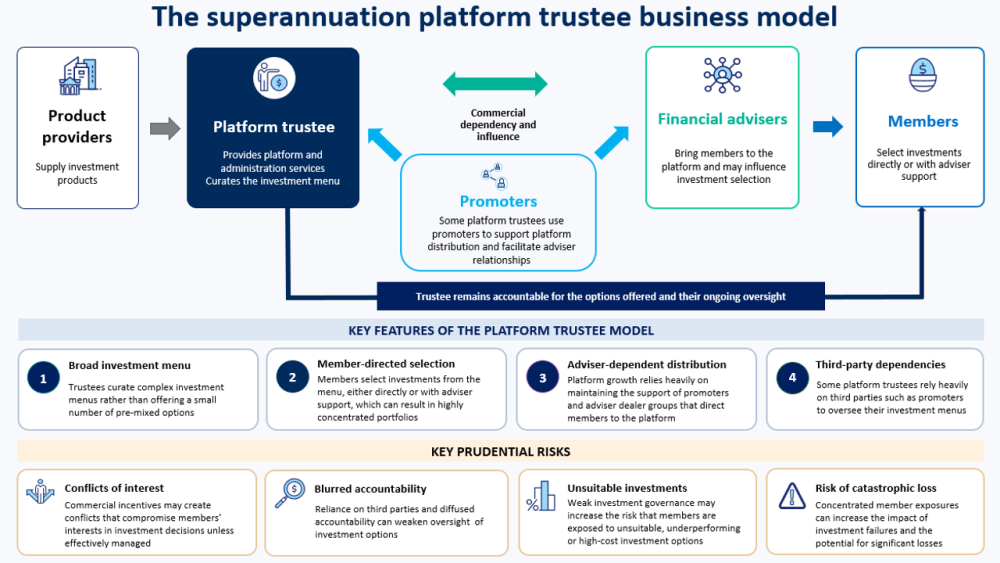
These developments are particularly relevant in the platform sector. Platform trustees often oversee large and complex investment menus, rely on adviser and promoter-led distribution, and allow members considerable discretion to concentrate their savings in individual investments. These features can make investments harder to oversee, create conflicts that may influence trustee decisions and increase the risk of severe loss where investments perform poorly or fail.
APRA’s supervisory work has found that these heightened risks have not always been matched by sufficiently strong governance practices. Weaknesses include inadequate scrutiny when investments are onboarded, ineffective monitoring and remediation, inconsistent enforcement of investment limits, poor management of conflicts involving third parties, and insufficient capability and resources to oversee complex investment menus.
APRA has elevated concerns about the platform sector, which has been the focus of intensified enforcement activity. While platform products represent around 15% of APRA-regulated superannuation assets, trustees offering platform products accounted for 70% of announced superannuation enforcement actions in 2025-26. APRA’s concerns occur in the context of the platform sector continuing to grow, with investments via platform products reaching $450 billion in June 2026, up 14% year-on-year.
The collapses of Shield and First Guardian illustrate the scale and severity of harm that can occur when members are highly concentrated in risky investments without effective trustee oversight and safeguards. Almost 12,000 members lost around $1 billion in retirement savings through Shield and First Guardian. Within APRA-regulated funds, losses were spread across 4 affected platform trustees, although 2 trustees subsequently provided compensation for capital losses.
APRA has undertaken extensive supervisory and enforcement activity to lift investment governance standards. This has included a thematic review covering trustees responsible for 95% of platform assets, an industry-wide direction for platform trustees to accelerate improvements and enforcement action against 5 trustees. This activity is driving improvements in practices. Nevertheless, material weaknesses remain, particularly in the platform sector, and existing requirements have not produced sufficiently consistent or timely improvement.
Policy reform is the next phase of APRA’s multi-year work to strengthen investment governance. It will address weaknesses identified through supervision and enforcement while establishing firmer minimum standards as investment offerings, distribution arrangements and trustee business models continue to evolve. The objective is to ensure trustees have the capability, controls and accountability needed to manage current and emerging investment governance risks.
APRA is proposing 8 changes: 3 reforms that introduce stronger safeguards and 5 changes that largely codify and strengthen existing expectations.
The 3 reforms focus on risks most evident in platform and other member-directed investment models. They would require trustees to:
• set and enforce member-level investment limits to reduce the risk of severe loss from concentrated investments in higher-risk options;
• strengthen conflicts management in relation to third parties, including advisers and promoters; and
• align trustee resources and capability with the size, complexity and nature of their investment offerings.
The other 5 changes would codify and, in some areas, strengthen APRA’s expectations for rigorous investment onboarding, ongoing monitoring, timely remediation, reliable valuations and clear accountability. They would translate expectations previously communicated through supervision and APRA’s 2025 industry letter into clear minimum requirements.
Together, the changes would establish a more complete investment governance cycle, from rigorous scrutiny before investments are made available through to consistent monitoring and timely action when concerns arise. Trustees would remain accountable for investment decisions made with the support of advisers, promoters, investment managers and other third parties.
The proposals would apply to all trustees because the underlying principles are relevant across the industry, particularly as member-directed offerings become more prevalent. APRA has sought to get the balance right by introducing stronger safeguards which in practice, are expected to have the greatest impact on platform trustees, where the identified risks and weaknesses are greatest without imposing disproportionate burdens on trustees with sound practices. Trustees with robust investment governance practices are not expected to be materially affected.
Stronger requirements involve trade-offs, particularly where member-level investment limits constrain the extent to which members can concentrate their retirement savings in higher-risk options. APRA has sought to preserve meaningful investment choice while ensuring that choice is supported by effective trustee oversight, independent decision-making, clear accountability and prudent risk controls.
Investment limits provide guardrails that limit choice, but they can materially reduce the scale of member loss where other controls fail. They would help protect members, support confidence in the superannuation industry, and limit the amount industry may ultimately need to contribute to compensation where failures occur.
The proposals would not fully eliminate the risk of losses or prevent every instance of member harm. Members will continue to bear investment risk, as appropriate in a defined contribution system. The proposals would, however, reduce the risks of severe member harm, as witnessed in Shield and First Guardian, and better equip the prudential framework to respond as investment products, distribution models and member preferences evolve. APRA’s proposals complement the Government’s proposed broader legislative reforms announced 19 August 2026 following the Shield and First Guardian collapses.
APRA invites written submissions on this discussion paper and the accompanying draft Prudential Standard SPS 530 Investment Governance by 3 February 2027. APRA expects to finalise the standard and release draft prudential guidance in the first half of 2027. Subject to consultation, the new framework is expected to commence on 1 January 2028.