

Executive summary
This Information Paper sets out the Australian Prudential Regulation Authority’s (APRA’s) conclusions with respect to the quantum of additional capital that might reasonably be expected to be required for the Australian banking sector to have capital ratios that are considered ‘unquestionably strong’.
Reflecting the social and economic cost of the global financial crisis, strengthened bank capital requirements have been at the core of the post-financial crisis international reforms. APRA implemented the first wave of these international reforms ahead of, and to a higher standard than was feasible in, many other countries, and has continued to strengthen the prudential framework in a number of other areas. This approach has not hindered the Australian banking system’s ability to support economic activity, and indeed Australia has benefitted from maintaining a robust and well-capitalised banking sector.
As a capital-importing nation, a significant component of Australia’s domestic investment is funded by foreign savings channelled through the banking system. While generally positive for domestic investment and economic growth, the reliance on foreign borrowing also makes Australia’s financial system vulnerable to a loss of foreign investor confidence. Recognising the risks associated with offshore funding, the need to ensure that Australia’s financial system continues to provide its core economic functions even in times of stress, and the benefits that flow from reducing the perception of an implicit government guarantee and the associated economic inefficiency this creates, the 2014 Financial System Inquiry (FSI) endorsed the benefits of a strongly capitalised banking system. Although acknowledging that the Australian banking system was generally well-capitalised already, the FSI recommended that APRA set capital standards such that capital ratios of authorised deposit-taking institutions (ADIs) are ‘unquestionably strong’. The Australian Government endorsed this recommendation.
At the time, APRA indicated that it would await the outcome of international work to finalise the Basel Committee on Banking Supervision’s capital framework reforms (commonly known as Basel III). This would allow for the international reforms, and the FSI’s recommendation, to be implemented as a single package. However, given the continued uncertainty as to the timetable for the finalisation of Basel III, APRA has concluded that it is now preferable to set out its assessment of the calibration necessary to achieve unquestionably strong capital ratios for Australian ADIs ahead of the international work concluding. APRA expects that any changes to the capital framework that may eventuate from the finalisation of international reforms will be able to be accommodated within the calibration set out in this paper, and will not necessitate further increases to requirements at a later date.
APRA’s assessment has been guided by a range of quantitative factors, including international capital comparisons, ratings agency methodologies, and stress test results. However, the calibration of the appropriate amount of capital is ultimately a matter of judgement, taking into account the requirements of APRA’s broader mandate, and considering a number of other aspects of resilience including liquidity and funding, governance and culture, risk management, and asset quality. It also takes account of the current and proposed legislative framework in which the banking system operates. It assumes, as the FSI recommended, that additional loss-absorbing capacity will be established in addition to unquestionably strong capital ratios.
In its assessment, APRA has focussed on the appropriate calibration of Common Equity Tier 1 (CET1) capital requirements, recognising that CET1 is the highest quality capital and therefore most likely to engender confidence in an ADI’s financial strength.
APRA fully supports the FSI’s recommendation that the concept of ‘unquestionably strong’ should apply to all ADIs. However, given the heterogeneity of the Australian ADI population, and the different approaches to measuring capital adequacy within the existing capital standards, APRA has distinguished in its analysis between those ADIs using the more conservative standardised approach to capital adequacy, and those banks that are accredited to use internal models to determine their capital requirements. The end result will be a narrowing of any difference in capital requirements between the two methodologies.
Calibration
ADIs using the internal ratings-based approach to capital adequacy
For ADIs that use the internal ratings-based (IRB) approach to credit risk, APRA has concluded that it will be necessary to raise minimum capital requirements by the equivalent of around 150 basis points from current levels to achieve capital ratios that would be consistent with the goal of ‘unquestionably strong’.
This calibration recognises that ADIs using the IRB approach are currently operating with a higher capital surplus above regulatory minimums, in anticipation of APRA’s implementation of the FSI’s recommendation. APRA therefore expects that some of the increase in minimum requirements might be met through reducing some of the surplus that these ADIs hold in excess of minimum regulatory requirements.
ADIs using the standardised approach to capital adequacy
For ADIs that use the standardised approach to credit risk, APRA has concluded that it will be necessary to raise minimum capital requirements by the equivalent of approximately 50 basis points from current levels to achieve capital ratios that would be consistent with the goal of ‘unquestionably strong’.
Many of these ADIs already hold a capital surplus substantially in excess of current minimum regulatory requirements and will likely absorb this increase within their existing capital resources without any need to raise additional capital.
Implementation
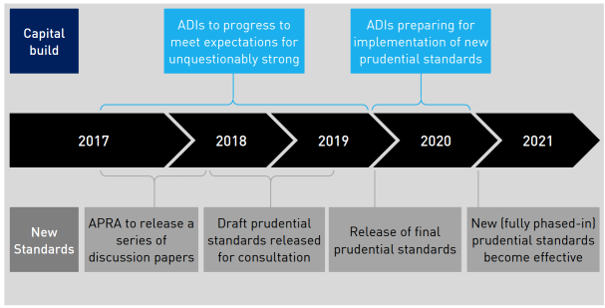
APRA considers that ADIs should, where necessary, initiate strategies to increase their capital strength to be able to meet these capital benchmarks by 1 January 2020 at the latest. This timetable is expected to allow for an orderly accumulation of capital by ADIs that need to do so, and facilitate a smooth implementation of new prudential standards that will institute these requirements.
Later this year, APRA intends to release a discussion paper on proposed revisions to the capital framework, designed to establish capital requirements that will underpin ADIs having unquestionably strong capital ratios. Subject to finalisation of the international reforms, this will outline the direction of APRA’s implementation of the forthcoming Basel III changes to risk-weights as well as measures to address Australian ADIs’ structural concentration of exposures to residential mortgages. It will also outline options APRA is considering to improve transparency and international comparability of ADI capital ratios.
Following the discussion paper, APRA expects to consult on draft prudential standards giving effect to the new capital adequacy framework in late 2018, leading to the release of final prudential standards in 2019. It is anticipated that these would take effect at the beginning of 2021.
APRA’s expectation that ADIs meet the capital benchmarks outlined in this paper by 2020, a year ahead of the expected effective date of the new prudential standards, reflects the importance to Australia of ADIs having unquestionably strong capital ratios, and that this should be achieved in a timely manner. By 2020, five years would have elapsed since the release of the final FSI report, and four years since the Government’s response. Against that background, APRA encourages ADIs to consider whether they can achieve the capital benchmarks more quickly.
Impact on the four major Australian banks
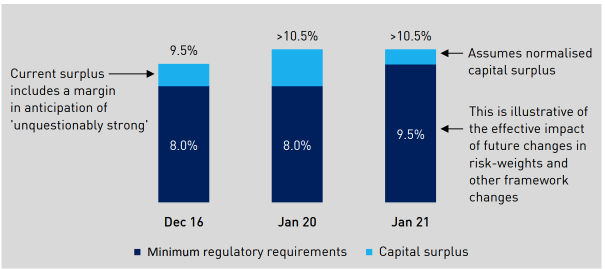
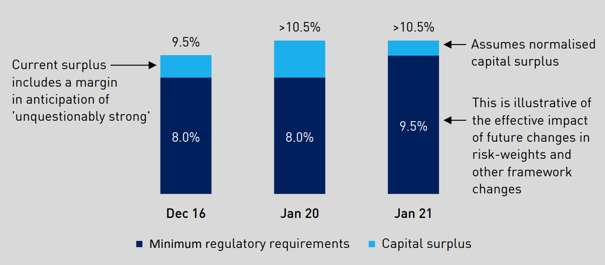
In the case of the four major banks, APRA expects that the increased capital requirements will translate into the need for an increase in CET1 capital ratios, on average, of around 100 basis points above their December 2016 levels. In broad terms, that equates to a benchmark for CET1 capital ratios, under the current capital adequacy framework, of at least 10.5 per cent. APRA expects the four major banks to meet this benchmark by 1 January 2020.
Figure 1: Illustrative example – major bank increase in CET1 capital requirements
It should be noted that this estimate of an additional 100 basis points of reported CET1 capital relative to the December 2016 position represents an average increase for the four major banks. The actual increases in CET1 capital ratios will vary from bank to bank. This impact is discussed in more detail in Section 3.6.
Outcome
In combination, the increased capital requirements foreshadowed in this paper will complete a significant strengthening of risk-based capital ratios within the Australian banking system in recent years. In meeting this new requirement, for example, the four major banks will have, on average, increased their CET1 capital ratios by the equivalent of more than 250 basis points since the release of the FSI report.
Stronger capital ratios will undoubtedly equip the Australian banking sector to better handle periods of adversity in the future. APRA will also continue to have regulatory and supervisory tools – both at the level of the system as a whole, and for individual ADIs – to respond to emerging risks as and when they arise. Stronger capital ratios cannot, however, provide a guarantee that one or more ADIs will not encounter periods of financial stress. In delivering a banking sector in which the Australian community can have confidence, it will always be necessary to complement a strong capital position with sound governance, risk management and internal controls within ADIs themselves, and active supervision by APRA.
Glossary
| Term | Definition |
|---|---|
| Additional Tier 1 (AT1) capital | Capital instruments that provide loss-absorption while the ADI remains a going concern, but do not satisfy all of the criteria for inclusion in Common Equity Tier 1 capital |
| ADI | Authorised deposit-taking institution |
| APRA | Australian Prudential Regulation Authority |
| Basel III | A series of reforms that commenced with the Basel Committee on Banking Supervision’s Basel III: A global regulatory framework for more resilient banks and banking systems, December 2010 (revised June 2011) |
| Basel Committee | Basel Committee on Banking Supervision |
| CCB | Capital conservation buffer |
| Common Equity Tier 1 (CET1) capital | The highest quality component of capital. It is subordinated to all other elements of funding, absorbs losses as and when they occur, has full flexibility of dividend payments and has no maturity date. |
| D-SIB | Domestic systemically important bank |
| FSI | Financial System Inquiry |
| IRB | Internal ratings-based approach to credit risk |
| IRB ADI | An ADI that has been granted approval from APRA to adopt the internal ratings-based approach for determining its capital adequacy requirements for credit risk |
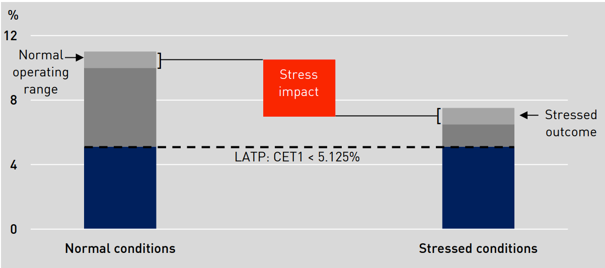
| Loss absorption trigger point (LATP) | The point at which an ADI’s Additional Tier 1 capital instruments are either written off, or converted into Common Equity Tier 1 capital. The LATP is reached when an ADI’s Common Equity Tier 1 capital ratio falls to 5.125 per cent. |
| Major banks | Australia and New Zealand Banking Group Limited (ANZ), Commonwealth Bank of Australia (CBA), National Australia Bank Limited (NAB) and Westpac Banking Corporation (WBC) |
| PCR | Prudential capital requirement |
| QIS | Quantitative Impact Study |
| RAC ratio | S&P Global Ratings’ risk-adjusted capital ratio |
| RWA | Risk-weighted assets |
| S&P | S&P Global Ratings |
| Standardised ADI | Any ADI that has not been granted approval from APRA to adopt the internal ratings-based approach, and uses the standardised approach to credit risk for determining its capital adequacy requirements |
Chapter 1 – Introduction
In December 2014, the Financial System Inquiry (FSI) presented its final report on the Australian financial system to the Australian Government. The first recommendation of the report was that the Australian Prudential Regulation Authority (APRA) should ‘set capital standards such that Australian authorised deposit-taking institution capital ratios are unquestionably strong.’
The Government subsequently endorsed this recommendation in its response to the FSI’s report.
In responding to the FSI’s recommendation that authorised deposit-taking institution (ADI) capital ratios should be ‘unquestionably strong’, APRA has sought – consistent with its statutory mandate - to balance the objective of improved financial safety and stability, with considerations of efficiency, competition, contestability and competitive neutrality.
1.1 Background
As a capital-importing nation, a significant component of Australia’s domestic investment is funded by foreign savings channelled through the banking system. While generally positive for domestic investment and economic growth, the reliance on foreign borrowing also makes Australia’s financial system vulnerable to a loss of foreign investor confidence.
Capital plays a fundamental role in any assessment of the financial strength of an ADI. High levels of capital increase the resilience of ADIs and so assist in maintaining market confidence during periods of financial stress. The FSI’s recommendation recognised that, to mitigate the risk of foreign investors withdrawing or reducing access to funding in times of stress, Australian ADIs should be, and be perceived to be, more resilient than international peer banks. While the FSI advocated that the aspiration of unquestionably strong capital ratios should apply to all ADIs, it was highlighted as being of particular importance for those that pose systemic risks or access international capital markets.
Although acknowledging that Australian ADIs were generally well capitalised, the FSI noted that, in its judgement, the Common Equity Tier 1 (CET1) capital ratios of the four major banks were not within the top quartile of international peer banks. A further strengthening of capital to increase the resilience of the banking system was therefore viewed as necessary and appropriate.
1.2 Objectives
APRA’s objective in implementing a framework for unquestionably strong capital ratios is to increase the financial strength of ADIs so that they are able to continue lending and providing other critical economic functions during periods of financial stress.
Achieving this objective requires that prior to a period of financial stress:
- ADIs have a high level of resilience relative to their international peers and are perceived as such by capital markets; and
- global capital markets are confident that the higher relative resilience will be maintained.
This pre-positioning seeks to ensure that during periods of financial stress:
- ADIs will act as shock absorbers, rather than shock transmitters or amplifiers, by being able to continue to lend and provide other critical functions (such as credit and payment services) necessary for economic activity;
- ADIs will be well placed to continue to access capital markets; and
- there will be a materially reduced likelihood of ADIs needing support from the public sector.
Achieving these objectives will also create a financial system that is more resilient to shocks and thus less prone to crises, which the FSI noted can have devastating and long-lasting effects on the economy and society. It will also reduce the perception of an implicit government guarantee for ADIs, and the associated economic inefficiency that this creates.
1.3 Implementation
This paper sets out APRA’s conclusions, from a top-down perspective, of the quantum of additional capital that might reasonably be expected to be required for the Australian banking sector to have capital ratios that are considered ‘unquestionably strong’.
To give effect to this overall level of capital, later this year APRA intends to issue a discussion paper on proposed revisions to the capital framework, designed to establish prudential standards that will underpin ADIs having unquestionably strong capital ratios. This discussion paper will likely propose a range of changes to the capital framework including:
- Basel III changes in respect of credit risk, operational risk and the capital floor; and
- other changes to address mortgage concentration risk and to improve transparency, comparability and flexibility.
Consultation on draft prudential standards would be expected to follow in 2018, with final standards to be determined in 2019 to take effect from early 2021.
Although on the above timetable the new prudential standards would not be effective until the beginning of 2021, APRA considers that ADIs should, where necessary, initiate strategies to increase their capital strength to be able to meet the capital benchmarks outlined in this paper by 1 January 2020 at the latest. This timetable is expected to allow for an orderly accumulation of capital by ADIs that need to do so, and facilitate a smooth implementation of the new prudential standards when they come into effect.
APRA’s expectation that ADIs meet the capital benchmarks by 2020, a year ahead of the expected effective date of the new prudential standards, reflects a balance between achieving unquestionably strong capital ratios in a timely fashion, and allowing ADIs to build capital in an orderly manner. By 2020 five years would have elapsed since the release of the final FSI report, and four years since the Government’s response. Against that background, APRA encourages ADIs to consider whether they can achieve the capital benchmarks more quickly.
APRA may support this expectation by phasing in minimum capital buffer requirements and other changes prior to 2020, on a case by case basis, if an individual ADI does not appear to be moving towards the benchmarks.
Figure 2: Implementation timeline
Chapter 2 – Calibration principles
In establishing standards that produce unquestionably strong capital ratios, APRA intends to strengthen the resilience of the system by ensuring that additional capital is of the highest quality, that the amount of additional capital is appropriately balanced with other measures of financial strength, and that the overall calibration reflects a medium-to-long term/through-the-cycle position that does not require regular recalibration.
The overall calibration should also recognise that APRA does not seek to operate a zero failure regime, and that while higher levels of capital can helpfully reduce the probability of ADI failure, it cannot and should not seek to guarantee against it.
2.1 Quality of capital
The calibration of standards for unquestionably strong capital ratios should focus on CET1 capital.
As the highest quality form of capital, CET1 capital is best able to absorb losses. The FSI therefore recommended that increases in capital ratios should primarily take the form of increases in CET1 capital.
APRA fully supports this approach; establishing unquestionably strong requirements for CET1 capital provides the most effective means of strengthening the resilience of the banking sector, and is most likely to engender confidence in an ADI’s financial strength.
2.2 Different measures of capital strength
The calibration of standards for unquestionably strong capital ratios should take account of a number of different measures of capital strength.
The calibration of standards for unquestionably strong capital ratios is ultimately a matter of judgement. Regulatory capital ratios are only one measure of financial strength, and APRA’s assessment should be guided by a broad consideration of available information. For the ADIs using the internal ratings-based (IRB) approach to credit risk (IRB ADIs), this includes measures such as international capital comparisons, ratings agency methodologies and stress test results. The heterogeneous population of ADIs using the standardised approach to credit risk (standardised ADIs) makes comparison across the ADI population or with peer banks in overseas jurisdictions more difficult, but should take account of similar measures where they are available.
2.3 Broader considerations of financial strength
The calibration of standards for unquestionably strong capital ratios should have regard to the broad range of factors that contribute to an ADI’s financial soundness.
While the FSI focussed on unquestionably strong capital ratios as the primary means of establishing confidence in the Australian financial system, capital is not the only contributor to an ADI’s financial strength. A holistic approach to achieving an unquestionably strong banking sector will consider not only capital strength, but also other indicators of financial soundness, including liquidity and funding, governance and culture, risk management and asset quality. It will also need to take account of the current and proposed legislative framework in which the banking system operates and, as the FSI also recommended, that additional loss-absorbing capacity will be established in addition to unquestionably strong capital ratios.
APRA’s supervisory philosophy will therefore continue to consider the full assessment of an ADI’s risk profile, and the environment in which it operates. In establishing standards that produce unquestionably strong capital ratios for the industry as a whole, APRA will continue to have the capacity to impose additional capital requirements where idiosyncratic risks exist in individual ADIs.
2.4 Medium-to-long term focus
The calibration of standards for unquestionably strong capital ratios should reflect the appropriate level of capital over the medium-to-long term.
Although the FSI recommended a baseline target in the top quartile of internationally active banks for determining unquestionably strong capital ratios, APRA has previously indicated that it does not intend to mechanically tie its standards to movements in international benchmarks, and is not attracted to an approach that would require regular recalibration of Australian capital requirements in response to movements in capital levels in other jurisdictions. Rather, APRA intends the calibration of its capital standards should reflect a foundational, through-the-cycle view of appropriate capital levels for Australian ADIs.
To the extent that temporary adjustments to industry-wide capital requirements are necessary – for example, in response to excessive credit growth – APRA has other tools, such as the countercyclical capital buffer and other supervisory measures, which it can use to influence capital levels in a more dynamic manner in response to emerging risks.
2.5 Non-zero failure regime
The calibration of standards for unquestionably strong capital ratios should acknowledge that APRA does not seek to operate a zero failure regime.
APRA’s 2014 Statement of Intent recognises that APRA cannot and should not establish a prudential framework that seeks to guarantee a zero rate of failure amongst prudentially regulated institutions.
Such a regime would impose significant cost on the Australian community, by unduly restricting the ability of regulated institutions to provide essential financial services.
The nature of the business of ADIs is risk-taking. In establishing standards that will generate unquestionably strong capital ratios, the goal should be to further reduce the risk of failure of an ADI, and thereby the risk of a call on taxpayer support, but stop short of attempting to eliminate this risk altogether. In other words, unquestionably strong capital ratios should not seek to remove, or be perceived as removing, the risk of ADI failure.
Chapter 3 – Calibration for IRB ADIs
3.1 Indicators of capital strength
APRA has used a number of different indicators of capital strength to assist in calibrating capital requirements for IRB ADIs that would be consistent with the goal of ‘unquestionably strong’:
- relative measures: in line with the FSI’s recommendation, the quantum of capital has been calibrated with a view to positioning Australian ADIs comfortably within the top quartile of international peer banks;
- alternative measures: ratings agency methodologies provide another means for assessing the capital strength of Australian ADIs; and
- absolute measures: the results of stress tests, which do not rely on relativities with other ADIs, indicate the level of capital required to survive severe but plausible adverse scenarios.
Consistent with APRA’s previous capital comparisons, the calibration focuses initially on determining a benchmark CET1 capital ratio for the four major banks. APRA intends that this benchmark be reflected in stronger prudential requirements to be applied consistently across all IRB ADIs (see Chapter 5).
For ease of comparison, APRA has sought to use data as at December 2016 wherever possible for the purposes of this analysis.
3.2 Top quartile positioning
3.2.1 International capital comparison study
The FSI recommended that ‘APRA should raise capital requirements for Australian ADIs to make ADI capital ratios unquestionably strong. A baseline target in the top quartile of internationally active banks is recommended.’
APRA has indicated previously that it does not intend to mechanically tie the calibration of Australian capital standards to movements in the capital levels of international banks. Nevertheless, top quartile positioning does provide a useful sense check as to the capital strength of Australian ADIs relative to their competitors for funding in international capital markets.
In recent years, APRA has sought to periodically estimate the capital strength of the four major Australian banks relative to their international peers. In July 2015, APRA released its International capital comparison study (July 2015 Study), which assessed the capital strength of the four major banks against international peers as at June 2014.
In the July 2015 Study, APRA adopted the top quartile of the Basel Committee on Banking Supervision’s (Basel Committee) Quantitative Impact Study (QIS) Group 1 banks as an appropriate and reliable measure of the top quartile of internationally active banks. To facilitate comparability with international peer banks, APRA applied a number of adjustments to both the numerator (capital) and denominator (risk-weighted assets (RWA)) of the four major banks’ capital ratios to account for APRA’s conservative implementation of the Basel Committee’s framework. These adjustments resulted in internationally comparable CET1 capital ratios approximately 300 basis points higher than the ratios calculated under the APRA standards applying at that time.
Despite this uplift, the average internationally comparable CET1 capital ratio of the four major banks (11.7 per cent) was around 70 basis points below the 75th percentile of QIS Group 1 banks (12.4 per cent). Given the strengthening of bank capital ratios that was continuing to occur internationally, the July 2015 Study also suggested that the four major banks would likely need to increase their capital ratios by at least 200 basis points relative to their position in June 2014 in order to ensure that their capital levels were comfortably positioned within the top quartile of international banks over the medium-to-long term.
3.2.2 Developments since 2014
Over the period June 2014 to December 2016, the average reported CET1 capital ratio of the four major banks increased by approximately 100 basis points. However, the effective increase in CET1 capital ratios over that period was closer to 180 basis points, after adjusting for the introduction of higher IRB risk-weights for residential mortgages, which took effect from 1 July 2016.
Figure 3: Change in four major bank average internationally comparable CET1 capital ratios
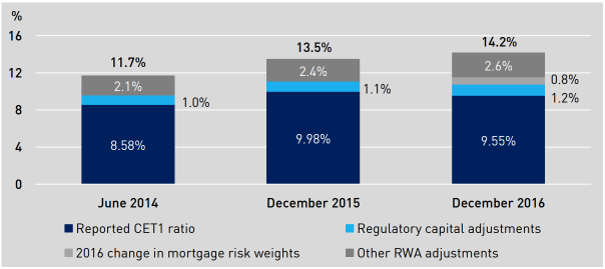
Applying the same comparison methodology as in previous analysis, including an adjustment for the introduction of higher IRB mortgage risk-weights, APRA estimates that as at December 2016, the average internationally comparable CET1 capital ratio of the four major banks was in the order of 14.2 per cent. This increase of 250 basis points in the internationally comparable CET1 capital ratio since June 2014 reflects the strengthening of CET1 capital ratios by the four major banks over the period (180 basis points), plus an additional widening (70 basis points) in the differential between the CET1 ratio under APRA’s requirements and the international comparison ratio.
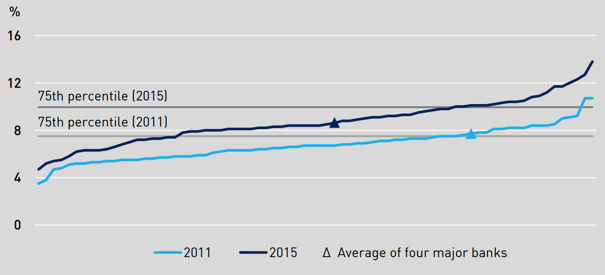
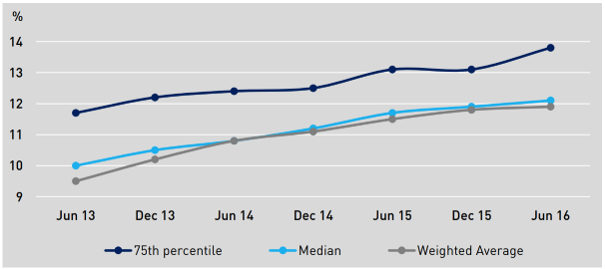
However, international peer banks have similarly evidenced strong growth in CET1 capital over this same period. The latest publicly available data is for June 2016, which shows the 75th percentile was 13.8 per cent. This represents an increase of 140 basis points since June 2014.
APRA expects that the 75th percentile will have increased further between June 2016 and December 2016. Over the past two years, the 75th percentile has increased by an average of 35 basis points each six months. While the most recent six-monthly increase in the 75th percentile revealed an even stronger increase (70 basis points), that may be partly reflective of the volatility that can be evident in a quantile estimate. The weighted average and median ratios have also increased but, in contrast, show signs of some tapering, which would be expected as international jurisdictions near completion of their phasing-in of Basel III changes. Nevertheless, whichever measure is used, it is clear that the general trend of a strengthening in capital ratios within the global banking system has continued.
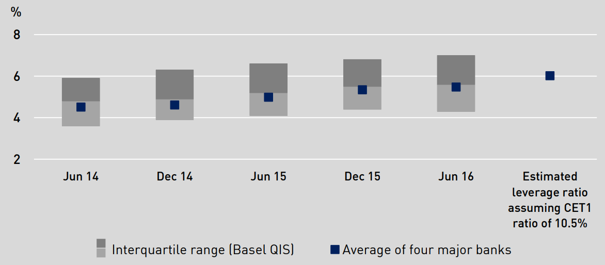
Figure 4: Recent trends in the Basel QIS Group 1 banks fully phased-in CET1 capital ratios
3.2.3 Results of latest analysis
For the purpose of assessing the amount of additional capital necessary to be comfortably positioned within the top quartile, APRA has compared the December 2016 average internationally comparable CET1 capital ratio of the four major banks against an extrapolated estimate of the 75th percentile level of international peers. Given that international capital levels are continuing to increase, albeit at possibly a more moderate rate than in earlier years, APRA has estimated that the 75th percentile is likely to be in the order of 14 per cent as at end December 2016. Figure 5 illustrates the movement in both the internationally comparable CET1 capital ratio of the four major Australian banks and the 75th percentile for the internationally comparable peers.
Figure 5: Major banks’ internationally comparable CET1 ratios against the Basel 75th percentile
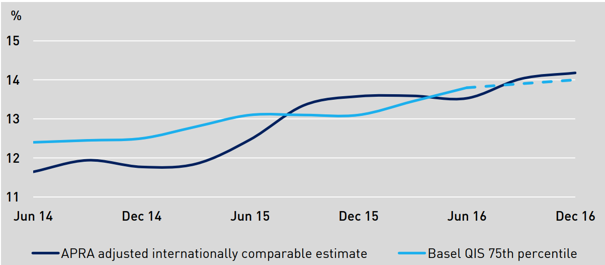
Figure 5 highlights that the significant growth in the internationally comparable CET1 capital ratios of the four major banks since June 2014 has, to a large extent, been mirrored by a corresponding increase in the 75th percentile level of international peer banks. Allowing for an element of imprecision in the extrapolation, this results in the December 2016 internationally comparable average CET1 capital ratio of the four major banks roughly matching the estimated 75th percentile point. Some further strengthening would therefore be needed if their capital levels are to be comfortably positioned within the top quartile of international banks, and likely to remain there over the medium-to-long term.
Given continued efforts to boost capital levels internationally, further increases in the 75th percentile remain likely. However, given that international jurisdictions are nearing the completion of their phasing-in of Basel III changes, APRA expects the rate of growth to taper. In estimating the capital ratios that would be necessary to establish internationally comparable capital ratios in the top quartile, APRA has allowed for some further growth in the 75th percentile, and then provided for a margin above this, given projection uncertainty and the objective to be comfortably positioned within the top quartile.
Taking the above into account, APRA has concluded that top quartile positioning, as recommended by the FSI, would likely necessitate internationally comparable CET1 capital ratios comfortably in excess of 15 per cent, or of the order of 100-150 basis points above December 2016 levels.
This is the equivalent of an additional 70-110 basis points in terms of reported CET1 capital ratios under APRA’s approach.
3.3 Ratings agencies
3.3.1 Importance of credit ratings agency assessments
Investors in bank debt and equity, and other financial market participants utilise information from a number of sources to assess the capital strength and resilience of banks. The major ratings agencies such as Fitch Ratings, Moody’s, and S&P Global Ratings (S&P) provide ratings information on banks to market participants and facilitate transparency in financial markets. Bank rating methodologies generally synthesise external and internal factors to arrive at an issuer credit rating for the bank or a rating for a particular debt or capital instrument being issued. This assignation of ratings allows investors to more easily assess the creditworthiness of a bank’s debt and capital issuance, and also has a direct impact on the funding costs faced by banks.
Given the influence of ratings agencies in the investment decision-making process, APRA has considered how their assessments may contribute to views on whether ADIs’ capital ratios are ‘unquestionably strong’. In this context, APRA has considered analysis based on S&P’s risk-adjusted capital (RAC) ratio, which S&P uses as an input in assessing the capital adequacy of a bank.
This ratio differs from the Basel framework calculation of regulatory capital ratios and so provides an alternative means of assessing capital strength.
The analysis presented below does not constitute in any way an endorsement of S&P’s ratings or methodology. The other main ratings agencies have either not published detailed capital methodologies or tend to utilise capital ratios based on the Basel framework as inputs into rating assessments.
3.3.2 Capital strength rating methodology
S&P assigns a bank a capital strength assessment on the basis of its RAC ratio. The classification of a bank’s capital strength assessment as ‘strong’ will, all else being equal, result in a one notch uplift to the stand-alone credit profile (SACP) of the bank. A ‘strong’ capital assessment requires a RAC ratio of at least 10 per cent and the expectation that it will remain at or above this level over the medium term.
It is not APRA’s goal to calibrate its capital standards such that Australian ADIs always have a ‘strong’ RAC ratio, or to recalibrate them in response to changes in S&P’s assessment. To the extent that factors influencing S&P’s assessment change in response to the evolving risk environment, this would impact the RAC ratio and hence the level of capital required to achieve and maintain a ‘strong’ capital assessment at any given point in time. However, averaging a RAC ratio above 10 per cent over the cycle would improve the likelihood of being perceived by financial market participants as having unquestionably strong capital ratios. It is therefore a useful benchmark against which APRA can calibrate its own requirements.
3.3.3 Results of latest analysis
The RAC ratio seeks to apply an internationally consistent approach to measuring capital adequacy, with eligible capital roughly equivalent to Tier 1 capital under the Basel framework and RWA driven by macroeconomic risks. As risk-weights for assets are assigned according to the economic risk score of the country to which the exposure is held, the RAC ratio is subject to substantial cliff effects if there is a change in the economic risk score, which is to be expected from time to time through the credit cycle.
The latest published average RAC ratio of the four major banks was 9.3 per cent, producing a capital strength assessment of ‘adequate’. All else being equal, achieving and maintaining a RAC ratio of greater than 10 per cent would allow for the potential reclassification of the capital strength assessment from ‘adequate’ to ‘strong’ and provide a one notch uplift in the SACP.
In May 2017, S&P announced that it had downgraded the economic risk score of Australia from 3 to 4 in response to the continued build-up of economic imbalances in the country.
Data provided by S&P suggests that this will have reduced the RAC ratios of the four major banks, on average, by approximately 90 basis points (i.e. from 9.3 per cent to 8.4 per cent).
Consistent with the principle that the calibration for unquestionably strong capital ratios is intended to be appropriate in the medium-to-long term, and therefore through the credit cycle, APRA considers that it is appropriate to conduct its analysis using a normalised economic risk score. Australia’s current economic risk score of 4 is representative of a heightened risk environment, and S&P considers that actions by Australian authorities should aid in an unwinding of the imbalances in an orderly fashion. APRA has adopted an economic risk score of 3 for the purposes of its analysis.
Based on 2016 data, and the assessment of economic and industry risks applying at the time, the four major banks would have needed to increase their RAC ratios by at least 70 basis points to be positioned within the ‘strong’ range under the S&P methodology. Although eligible capital under the RAC ratio more closely approximates regulatory Tier 1 capital, consistent with the calibration principles set out in Chapter 2, APRA expects that additional capital raised would be in the form of CET1.
Accordingly, APRA has expressed the amount of additional capital required on a CET1 basis.
Changes in the reported CET1 capital ratio do not correspond one-for-one with changes in the RAC ratio; the most recent S&P reports as at December 2016 indicate that the major bank average denominator in S&P’s measure (RWA calculated under the RAC methodology) was approximately 40 per cent higher than the corresponding regulatory measure. Given these differences, APRA estimates that an increase in average reported CET1 capital ratios of approximately 110 basis points would have been needed to achieve an average RAC ratio of 10 per cent.