


To: All RSE licensees
As part of its package of initiatives to reform the retirement phase of superannuation, the Government has tasked APRA with giving effect to the Retirement Reporting Framework (Framework).
The Framework is intended to improve understanding of how RSE licensees support their members to navigate retirement and provide enhanced transparency for members, industry and policymakers on emerging trends in the retirement income system.
The Framework Design Specifications released by the Government in February 2026 set out the high-level indicators, metrics and member cohort attributes for the collection. APRA is responsible for designing the detailed reporting standards, forms and instructions needed to implement those specifications.
Following two rounds of extensive consultation with industry and broader stakeholders, APRA has today released final versions of the reporting standards and guidance to support implementation of the Framework.
In developing and refining its reporting standards, APRA has listened to the valuable and considered feedback from stakeholders and sought to balance the objectives of the Framework with the need for practical and proportionate implementation requirements. APRA’s aim is to deliver a quality, fit-for-purpose framework that reflects the Government’s objectives while avoiding unnecessary regulatory burden.
Accompanying this letter are final versions of:
- Reporting Standard SRS 607.0 RSE Business Model (SRS 607.0);
- Reporting Standard SRS 611.1 Retirement Member Profile (SRS 611.1);
- Reporting Standard SRS 101.0 Definitions for Superannuation Data Collections (SRS 101.0);
- Reporting Practice Guide RPG 611.1 Retirement Member Profile (RPG 611.1).
For each reporting standard, APRA has published both a clean version and a version marked up against the September 2026 consultation draft.
APRA has also released an updated Technical paper: Calculations and mapping of Retirement Reporting Framework indicators and metrics to APRA’s reporting standards, as a reference source for stakeholders.
Consultation overview
On 10 September 2026, APRA released its response to feedback received on the initial consultation, which ran from March to June 2026. This included revised reporting standards incorporating a range of simplifications and additional instructions based on industry feedback.
Following a four-week consultation, APRA received 9 submissions from a broad range of stakeholders, including RSE licensees, industry associations, consumer representatives and reg-tech companies.
Overall, stakeholders were very supportive of APRA’s revisions, noting the reduction in complexity across Reporting Standard SRS 611.1 and the additional examples provided in the Reporting Practice Guide RPG 611.1.
Some industry stakeholders proposed a deferral of the implementation timeline, specifically that the initial reporting of data be delayed from Q4 2027 by a further twelve months.
Feedback also covered the importance of appropriately translating the collected data into the published Framework. This included ensuring that limitations affecting certain populations and the use of proxies are clearly explained, and that the effects of different business models, RSE demographics and arrangements with third-party providers are considered and reflected in the publication.
Summary of APRA’s response
Following consideration of submissions and further engagement with industry and Treasury, APRA has made further revisions to its proposals.
First, in light of industry feedback regarding implementation challenges, APRA has extended the deadline for the first data submission from Q4 2027 to 31 March 2028. This extension provides RSE licensees with some additional implementation lead-time. This adjustment does not change the first reporting period (the year ending June 2027) or the timing of publication of data by APRA.
Second, APRA has made targeted clarifications to the final reporting standards and expanded the Reporting Practice Guide. These changes incorporate additional examples and guidance on scenarios raised by stakeholders, while preserving the overall design of the collection.
Third, as previously advised, APRA will undertake further engagement on publication design from Q2 2027. This work will consider the most recent feedback on how best to provide appropriate context for the published indicators, including limitations affecting particular member populations, the use of proxies, and differences in business models, RSE demographics and arrangements for delivering advice and other member-support services.
APRA has also made some minor drafting updates to the reporting standards and reporting practice guide.
Further detail on APRA’s response is provided in Attachment A.
Next steps
The due date for the first data collection has been extended to 31 March 2028. The implementation timeline has been updated accordingly and includes APRA’s planned engagement on publication design in 2027. The adjusted implementation timeline is provided in Attachment B.
APRA intends to release the reporting forms and taxonomy into the APRA Connect external test environment in Q1 2027. Industry participants are encouraged to use the test environment before reporting commences to familiarise themselves with the submission process, build and test their reporting solutions, undertake trial submissions using test data, and identify and resolve any system or data issues before go-live.
APRA appreciates the ongoing engagement of industry and other stakeholders as implementation of the Framework progresses.
Yours sincerely,
James Douglas
General Manager, Superannuation
Australian Prudential Regulation Authority
Attachment A – Summary of APRA’s response to final consultation
Implementation and transition
Implementation approach for first reporting collection
APRA has extended the first collection due date to 31 March 2028, providing additional time for implementation and testing following the release of the final standards and taxonomy. Given this additional time and the need for reliable data to underpin public reporting, APRA will not adopt a best-endeavours approach or allow proxies or estimates. APRA will support industry readiness by providing taxonomy artefacts and reporting forms in the APRA Connect external test environment, so entities can test solutions and resolve system or data issues before reporting commences. Subsequent reporting will be due within three months of the end of the relevant reporting period, consistent with existing annual reporting timeframes.
Reporting methodology and additional guidance
Metric 2 – Average pension drawdown
Enhanced SRF 611.1 Table 1, Column 19 instructions to clarify the treatment of multiple and part-year pensions and the calculation of member-level drawdown rates. These changes align with the Reporting Practice Guide and clarify that the cohort average is calculated using a simple average.
Metric 2.1 – Minimum drawdown scenarios
Added guidance to the Reporting Practice Guide for pensions commencing in June where no minimum payment is required.
Metric 3.2 – Accounts closed due to unclaimed money payments
Simplified instructions in SRF 611.1 Column 3 of Tables 2 and 3 and clarified Reporting Practice Guide guidance on payments to be reported under the category ‘other reason - superannuation member benefit’.
SRS 611.1 – Treatment of reversionary beneficiaries and non-reversionary beneficiaries
Clarified guidance in the Reporting Practice Guide on reporting deceased members, and on beneficiaries commencing a new pension, in SRS 611.1.
Retirement income products and advice arrangements
Indicator 2.2 – Lifetime income products
Expanded instructions in SRF 607.0 Tables 6A, 6B and 6C to clarify reporting expectations and confirm that products open to new members must be reported.
Indicator 2 – Access to lifetime income products
Clarified in the instructions for SRF 607.0 Table 7 item 4.1 that relevant referral arrangements are limited to contractual arrangements between an RSE and issuers of lifetime income products.
Publication design and confidentiality
Publication design
As part of its planned engagement on publication design from Q2 2027, APRA will consult a diverse range of stakeholders on the contextual information needed to support interpretation. This will include exploring the following matters raised by stakeholders:
- Personal advice: Members may receive personal advice through other mechanisms not captured by Indicators 3.1 and 3.2.
- Member engagement: Members may be reported as inactive under SRF 611.1 Table 1, Column 11 because they are not making contributions, while remaining engaged in other ways.
- Balance utilisation (Metric 3): Results may be skewed where a member holds multiple pensions and one of those pensions has been held for a number of years.
- Average drawdown (Metric 2): Results may be skewed by annualising payments from pensions held for only part of the year.
Confidentiality
APRA’s publication design will protect member privacy and commercially sensitive information. APRA confirms that systemic longevity risk bearer and third-party retirement income stream provider information collected in SRF 607.0 Tables 6 and 7 is intended for APRA supervisory use, not publication.
Clarifying reporting requirements and terminology
Minor drafting and terminology corrections
APRA adopted targeted drafting, typographical and labelling corrections across SRS 101.0, SRS 607.0 and SRS 611.1 to improve clarity. APRA will determine an updated SRS 101.0 as a legislative instrument at the same time as SRS 607.0 and SRS 611.1. At that time, SRS 101.0 will also incorporate changes arising from APRA’s response to consultation on Transition of Superannuation D2A data collections to APRA Connect.
Feedback considered with no change required
Some feedback was not adopted because it had been considered previously, would have impacts for other reporting standards, could require consequential amendments or would expand the scope of the collection. This included suggestions to define ‘member’ in SRS 101.0; include lump sums in total income stream payments; change age bands; collect total superannuation balances across Tables 2 and 3; and collect additional information on advice costs or the demographics of members who take up advice.
Attachment B – Adjusted implementation timeline
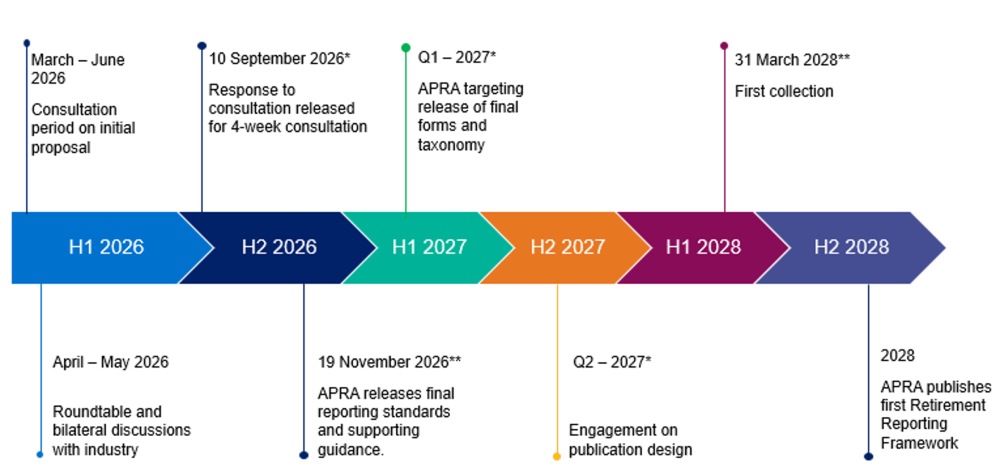
Notes
* indicates an adjustment has been made compared to the timeline included in the March 2026 consultation paper.
** indicates an adjustment has been made compared to the timeline included in the September 2026 response paper.